
Why do I travel?
“The real voyage of discovery consists not in seeking new landscapes but in having new eyes.”
~Marcel Proust
A friend of mine once told me that one night after work, she visited an eye doctor who dilated her pupils to look at the back of her retinas, a routine eye test. The doctor warned her that her vision might be blurry for a few hours, but she didn’t see any difference while under the harsh fluorescent lights in the doctor’s office. But once she stepped outside into the New York City night, the city was transformed. Every streetlight was a sparkling starburst, every traffic light a radiant rainbow, and when she looked up, the lights coming from the thousands of skyscraper windows had turned into shooting stars. It was like fireworks shooting off everywhere she looked. She walked around the “familiar” city, amazed. She remembered that this was what the city had looked like when she was a child. That started to make me think! If it was me who had my eyes dilated, perhaps I would have seen those fireworks too, or perhaps I might learn to see them anyway without the help of an optometrist, the way I saw a “different” Poland, when I first went back after an absence of three years. The landscapes that seemed to be gray and dull for the most of my childhood and teenage years, now presented themselves to my delight as playgrounds of light, habitats of colorful trees, full of character and personality. What I had never seen before was the quality of the light which, unlike equatorial light, changes in enormous shifts, a world in which every single cloud counts more. It was the same landscape, the same country, the same eyes but a completely different view.

For the traveler coming back home after a long absence, there awaits a renewed appreciation of places and things, well-known and yet different. The familiar is not so much altered – it is the traveler who has been changed by the experience of leaving. We become accustomed to places and things and tend not to see them even though they are right in front of our eyes. To see beneath the surface of the ordinary, to see new possibilities within the old and familiar, requires a “recalibration” of our eyes–bringing a new eye, or ear, or heart, to the way the world appears to be. The traveler returning home experiences new encounters with the familiar that allows him or her to become lost in the novelty of sensation, surprise, and discovery, in the freshness of seeing old things in a new way, of seeing the common and expected in an astonishing way … and that is why I travel.

Isn’t it strange when suddenly places and things that were once imperceptible by me for so many years suddenly unveil themselves? Have you ever noticed how we cannot see things because we “forget” to see them? We forget to look at them, because they are always in front of us, every day – they are commonplace. We have a kind of visual amnesia, a forgetting of places and things right in front of us, a blanking out of our consciousness and awareness. But this is how we experience a new way of seeing that often changes our lives.

Not only places can become icons, books can become icons too. As soon as the thought or acts are imprisoned on the page, something ghastly happens to them, and they become nothing more than records. If you have ever seen dead coral you will grasp the truth of this. It is beautiful under the water in its natural environment, but as soon as you rest that gorgeous object on your table it begins to lose its beauty. It becomes nothing more than a white piece of limestone-like rock. The same happens to ideas and experiences as soon as they are transferred into words. They are removed from the living state in which they grow, transformed from a first-person experience to a third-person pre-formulated proposition, from something experienced to something only read.
Similar comparisons apply to another important invisible object – people. How often do you take an inventory of the physical presence of a close friend? It seems that when we spend time with friends and family, we tend to see and hear them as only an idea, a static recording, etched in the material of our consciousness, rather than the living and breathing individuals they are right at that very moment. We completely forget to maintain our awareness of the people, and they lose their real and physical presence in our private internal world. What I am realizing is that as we become familiar with people, they become symbols or concepts to us. Every time I am asked a question like “What is your major?” or “What do you do for living?” I feel eaten alive by my career choice — I have become a symbol of it. I am not talking about spending too much time working, but rather about allowing people to define me in those limiting terms. These kind of questions are pre-formulated, pre-programmed, and the information they solicit is given more weight than it should. But there are people to whom I matter, for whom my history is never finite, those who will seek with great curiosity to know me better and better, but will never be tempted to state that they know me all the way through. I will never become “familiar” to them.
After all, to see eternity in the moment or in the person is to see the moment for itself in its entirety, to live in the present without being restricted by the past, as well as to see infinity in the finite.

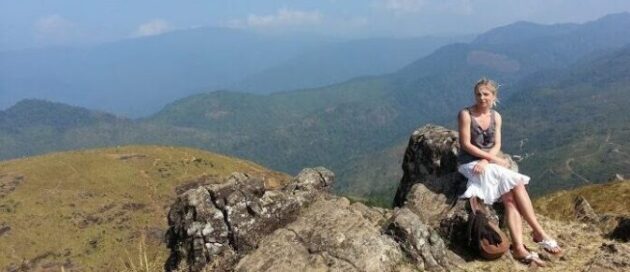
So how can we maintain this consciousness of places and people and is it necessary to do so? I am not certain that we can keep up this heightened level of awareness at all times but travel definitely recalibrates your eyes and allows you to see the same old stuff in a new way. Every single trip that I took, hiking Denali Park in Alaska, climbing Mount Aconcagua, Mount Elbrus or Mount Kosciuszko, sailing Mazury Lakes, Baltic Sea or Atlantic Ocean did magic to my vision. So as far as places go, perhaps one of the reasons that so many people enjoy traveling is the jolt the unanticipated can offer. The new place is looked at with fresh eyes, seen for the first time, as if through a child’s eyes-different landscapes, unusual food, and check out the funny telephones/toilets/teapots! But perhaps that is what we need, the shock of the strange and unexpected. Without it, might we not sink into a malaise, all of us, even whole societies? After all, our ancient ancestors were nomads-wandering is in our blood. Many people in this society move across the country, change jobs, get divorced, or all of the above. Teenagers jump from relationship to relationship every few months, get their thrills out of being “in love,” and mostly waste a lot of time with strangers. It is their way of practicing at life, their way of seeing the world anew. But most of us adults, not having so much free time to waste, eventually decide to take the harder road and settle down with someone who, after a while, may seem predictable and safe and possibly boring. And unless we keep our awareness of that person on high alert and make an everyday effort to rediscover that person, we wind up divorced or living dull and tedious lives.

All of us humans hold within us the odd combination of timidity (embracing the familiar) and curiosity (the siren call of the unknown.) Everything around us sooner or later becomes familiar and no longer unpredictable. We love the familiar, but it has a stranglehold on us. Who could blame us for the eagerness to develop the ability to drill below the surface of the world, through ideas in the books that have hardened over the years to become dogma, through the icons representing the people in our lives, through the landscapes and landmarks of our times, even if it means taking risks and relinquishing some of the safety and security that the familiar offers. Without taking that risk, we sacrifice the possibility of seeing a new kind of reality.


Comments
Very well written. Good luck and keep on posting.