
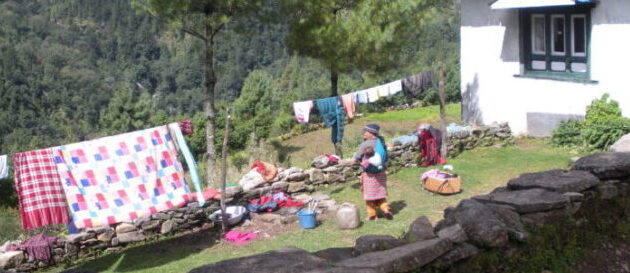
People I met in Nepal.
“People are guests in our story, the same way we are guests in theirs. But we all meet each other for a reason because every person is a personal lesson waiting to be told.”
– Lauren Klarfeld

As I placed my hands together, smiled and said “Namaste”, I observed them as they repaid my gesture with honest smile of acceptance. I felt welcomed, I was their guest. Nepalis are one of the most friendly people I have met. Namaste, the communal form of greeting each other in Nepal, means in Sanskrit “the divine in me honors the divine in you”.
Determined not to give my mom a heart attack, I had to hide from my family, that I was planning to hike to Mount Everest Base Camp. It was difficult to convince them, that this journey and actually climbing Mount Everest are not at all the same thing. My friends were slightly more supportive, but I still received the same shocked and wide-eyed response: “You are not!” Of course, the excursion was not without risks, but they lay in unforeseen places, like Lukla airport, which is considered one of the most dangerous airports in the world – and in fact, a fatal crash occurred while I was there, on the same day that I was returning to Kathmandu, but on an earlier flight.

Base Camp is located at 17,600 feet, well below the peak of Mount Everest (29,000 feet). It is a starting point, where those planning to summit spend weeks acclimatizing for their climb. It is also the furthest you can go on your feet, without using equipment like ropes, crampons and ice axes. The Everest Base Camp trek offers an opportunity for regular trekkers like me, to tackle an achievable portion of the highest climb in the world … so, I went for it!

Nepal is a country of welcoming people, stunning scenery, and a large diversity of cultural traditions. Staying predominantly in tea houses along the path, allowed me to ease into the lively sherpa culture, inhale the scents of rhododendrons and other shrubs, and take pictures with friendly herds of yaks. I could go on and on about the logistics and beauty of this trip, but I am going to save it for one of my next stories. This tale is about people, people of Nepal.
As a visitor, sometimes I just like to bypass the much-frequented places and activities and chat with the local people, to learn more about their daily lives. I was determined to overcome cultural differences and language barriers, ate at local stalls, grabbing a bench and a bite at a dingy little places visited mostly by Nepalis. All would be much better if I knew some Nepali language.

Nepali people are kind, tolerant, warm and proud of their traditions, faith, music and culture. Hindu temples alternated with Buddhist stupas and people have harmony and peace, apart from cultural diversity. They are patient and good humored, rarely hostile or angered, spend a lot of time outside meeting for chatting or celebrating. Their daily life is full of rituals and prayers towards gods who coexist in their daily life rather than being an abstract idea. Even city life, although on the outside it looks more modern, is full of traditions that persisted the same as they were centuries ago. Much of the festivals are celebrated precisely as they were for centuries with natives representing forgotten kings who once reigned over their ancestors.


Just by witnessing life in Nepal, chatting with local people and taking an interest in them you can discover a great deal. A phrase known by every Nepali is ‘Guests equals God’. Offering everything one has to a visitor is considered a honorable obligation and is taken seriously by the Nepali people. A Nepali family once presented to you is very likely to invite you in for a meal. Even the poorest citizens will share their food with visitors. Instead of asking “How are you?”, they will ask you “Have you had your meal?” or “Have you had your tea?”. Perhaps, this is the main cause, why a traveler cannot remain a traveler for very long in Nepal. Once I started to appreciate the place and its people, I was no longer an outsider – I become a respected guest, a guest that was even invited to dance parties.

It’s intriguing to learn how people have adjusted to their environment in incredible ways. Because of the remoteness of the mountains people’s lives have only changed very slightly in the last century. You can still encounter caravans of yaks carrying essential goods to distant settlements in the Himalayas. Ox carts still transport crops from the fields, firewood is still a main source of energy, people make their own comforters and shoes and villages look like an open air folk museums.


Family values are very important to Nepalis, and it is not uncommon for extended families to all live together under one roof, although this has become a challenge to some as many men have to seek work away from home, either in the bigger cities such as Kathmandu or abroad. Most of the women in Nepal are not as educated as men. They get married and care for their husbands, children and homes. Although they officially have the same rights as men and underage and forced marriages are forbidden, the old traditions are deeply rooted in peoples’ minds.

Having a guide and porters was a great way to get to know more about local life in Nepal. Because I was hiking with them all day, every day, I had plenty of time to chat. Especially interesting were evening chats over dinner and beer, Everest beer of course!

Throughout the trip, I had this undescribed urge to learn all I can about the guy who carried my backpack for two weeks, wearing just flip flops or canvas sneakers and a t-shirt, when I had my hiking boots, fleece sweatshirt and waterproof jacket on to protect me from water and cold. While guides generally speak decent English, porters usually don’t. Every night I would buy him a beer at a local tea house and tried to get out from him as much as I could. He was a man of few words, only spoke a limited English and carefully formulated his answers as to not wanting to say the wrong thing. He was a young men, maybe in late twenties, but his face looked much older. The harsh mountain weather and hard work both made a mark on his face. Every year, in the spring, he would leave his wife and two small children and walk from his village to Lukla, a trip that took him three days, to work non-stop for 3-4 months as a porter. It was his third season of carrying backpacks and other climbing equipment to and from Mount Everest Base Camp. All he had with him were 2 pairs of shoes, 2 shirts (one short and one long sleeved), one pair of pants, a hat and a flip cellphone. He was making probably 1-3 dollars a day, but was very grateful for the opportunity to do a job that allowed him to provide for his family.
As we said our goodbyes in Lukla, I thanked him for helping me reach my goal, gave him all the sweets I had left for his children, my hiking boots, one sweatshirt, sandals, umbrella and some other small items that I thought he could use and would make his life easier. I don’t remember his name and will most likely never meet him again, but if our paths cross I would always recognize his serene and accepting face.
Photo credit: Katarzyna Jakubczyk, Justyna Lewandowska, Julia, Kawa, Agata Gulbierz, Katarzyna Kowalik, Jan Palasik


Comments
Lovely article and photos!